Somewhere in the last five years, “sales analytics” got rebranded. The new label is revenue intelligence, and if you sit anywhere near a B2B pipeline, you’ve probably heard it pitched by Gong, Clari, or 6sense. The term sounds like marketing fluff. The category underneath it is real.
Here’s the short version: revenue intelligence is software that captures what’s actually happening in your deals — calls, emails, meetings, buyer engagement — and uses AI to tell you which deals are healthy, which are stalling, and what your quarter really looks like. Your CRM tells you what reps typed in. Revenue intelligence tells you what happened.
Where the category came from
Gong coined the term back in 2019 to describe its move beyond call recording into full deal analysis. For a while, “revenue intelligence” and “conversation intelligence” were nearly interchangeable. That’s no longer true.
The category has been consolidating fast. Clari and Salesloft completed their merger in December 2025, combining forecasting with sales engagement. That same month, Gartner published its first-ever Magic Quadrant for what it calls Revenue Action Orchestration — a signal that analysts now treat this as a distinct market, not a CRM add-on. And in February 2026, Gong expanded its platform into enablement and account management. Everyone is racing to own the full funnel.
What it actually does that your CRM doesn’t
CRM data has a well-known problem: it’s only as good as what reps enter, and reps are busy. Stage fields go stale. Close dates get pushed without explanation. A deal marked “commit” might have had zero buyer contact in three weeks — and the CRM has no idea.
Revenue intelligence platforms fix this by pulling from the systems where deals actually live. Four capabilities show up in almost every serious platform:
- Activity capture. Emails, calls, and meetings get logged automatically, so the deal record reflects reality instead of rep memory.
- Conversation intelligence. AI transcribes and analyzes sales calls — who talked, what objections came up, whether pricing or competitors were mentioned.
- Deal and pipeline signals. The platform flags risk: single-threaded deals, ghosted follow-ups, engagement that dropped off after the demo.
- AI forecasting. Instead of rolling up rep-submitted numbers, the system projects the quarter from observed deal behavior.
The newer platforms add a layer on top: recommended next actions. Gartner’s May 2026 survey found that sales organizations providing AI-enabled next best actions were 2.6x more likely to achieve commercial growth than those that didn’t. That stat is doing a lot of work in vendor decks right now, but the underlying point holds — teams acting on observed signals outperform teams acting on gut feel.
Why the money is flowing in now
Three reasons, roughly in order of importance.
First, forecast pain is universal. Ask any CRO how confident they are in the number their team submitted, and watch their face. Boards have less patience for missed quarters than they did in 2021, and “the pipeline looked fine” is no longer an acceptable answer.
Second, AI made the analysis practical. Transcribing ten thousand sales calls and finding patterns across them wasn’t feasible at a reasonable cost until recently. Gartner predicts that by 2027, 95% of sellers’ research workflows will begin with AI, up from less than 20% in 2024. Revenue intelligence is one of the first places that shift is showing up in budgets.
Third, the market is growing — though be careful with the numbers. Analyst estimates for the category range from roughly $2.3 billion to $6.4 billion depending on who’s counting and what they include, with projected growth rates between 8% and 15% annually. When estimates vary that much, the honest read is: the category is real, it’s growing, and nobody agrees on its edges yet. Treat any single market-size number in a vendor pitch as directional, not fact.
The blind spot nobody mentions in the demo
Here’s the catch. Revenue intelligence starts working when a deal exists — a contact record, an opportunity, a rep on the account. Everything before that moment is invisible to it.
And that’s most of the buying journey. The buyer research we covered in August points the same direction: roughly 70% of the B2B buying journey happens before a prospect ever contacts sales. They’re reading your pricing page, comparing you to competitors, and forming a shortlist — anonymously. A revenue intelligence platform can score the deal beautifully once it’s created. It can’t tell you about the deals that never became deals because nobody knew the buyer was there.
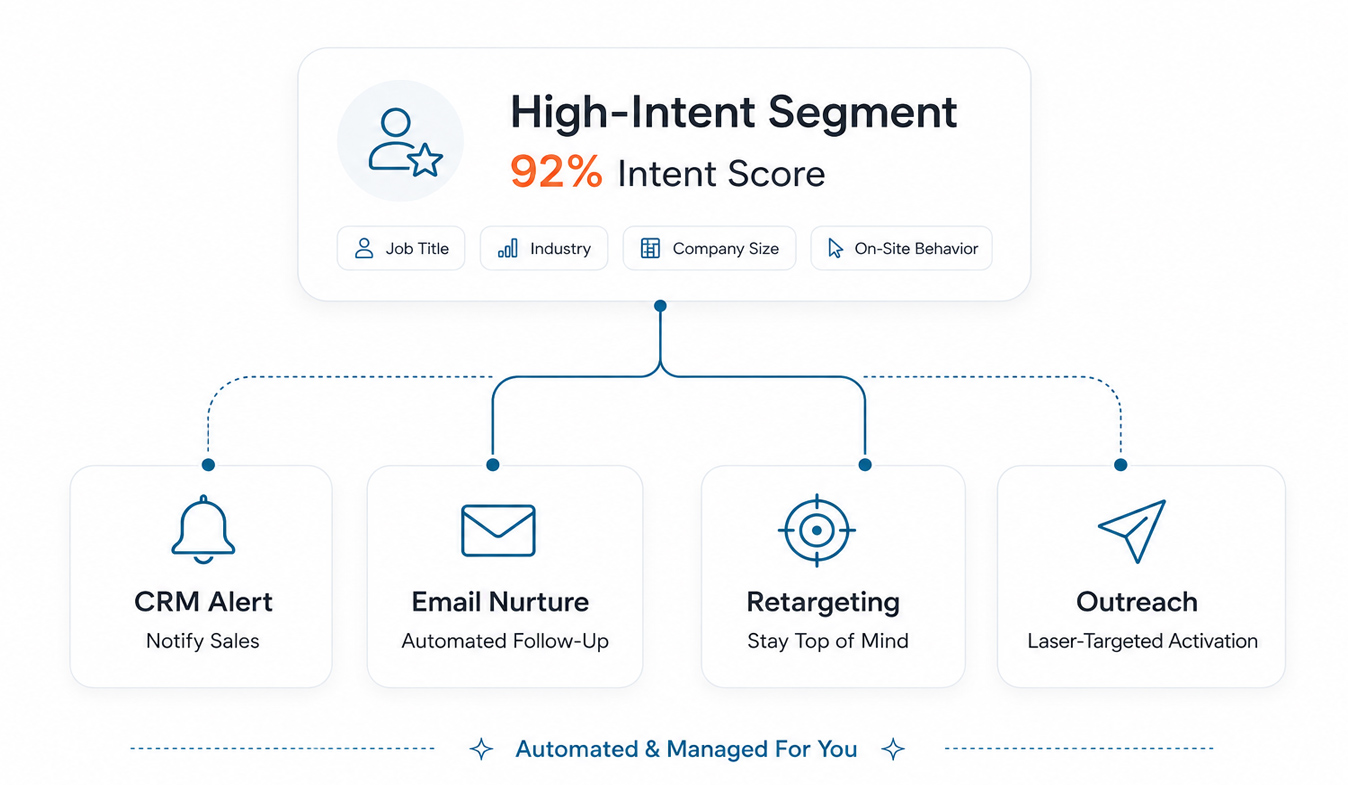
That’s a different problem, solved by different tools: visitor identification and intent data cover the anonymous, pre-CRM stage of the journey. If you’re evaluating revenue intelligence, it’s worth asking where your funnel actually leaks. Plenty of teams have clean pipelines and starved top-of-funnel — and no forecasting AI fixes that.
Should you buy one?
A rough decision framework, no vendor spin:
- You probably need one if you run a team of 10+ reps, your forecast regularly misses by more than 15%, and deal reviews rely on rep narrative instead of data.
- You can probably wait if you have fewer than five reps and your founder or sales lead still hears most calls directly. At that size, the platform mostly confirms what you already know.
- Either way, fix your data inputs first. A revenue intelligence layer on top of a CRM full of stale, incomplete records produces confident-sounding nonsense.
One more thing on pricing: most platforms in this category charge per seat, and the quotes climb quickly once you add forecasting modules. Get the full three-year cost in writing before you commit. The demo price and the renewal price are rarely the same number.
The bottom line
Revenue intelligence is a real category solving a real problem: CRMs record opinions, and these platforms record evidence. The consolidation wave — Clari-Salesloft, Gartner’s new Magic Quadrant, Gong’s expansion — says the market believes the pitch.
Just go in clear-eyed about what it covers. It makes the deals you know about more predictable. It does nothing for the buyers you can’t see. Most B2B teams need help with both, and only one of those problems comes with a Magic Quadrant.