What Most Marketers Get Wrong About Intent Data
Ask ten marketers what “intent data” means and you’ll get ten different answers. Some will say it’s just website visit data. Others will describe it as a purchased list of companies researching a topic. A few will shrug and admit they’ve heard the term but aren’t really sure what it means in practice.
This confusion is costly. Intent data is one of the most powerful levers available in modern marketing — but only when you understand what it actually is, where it comes from, and how to use it correctly. Get it wrong and you’re wasting budget on audiences who were never in-market. Get it right and you’re reaching buyers at the exact moment they’re ready to engage.
Let’s break it all the way down.
Intent Data, Defined
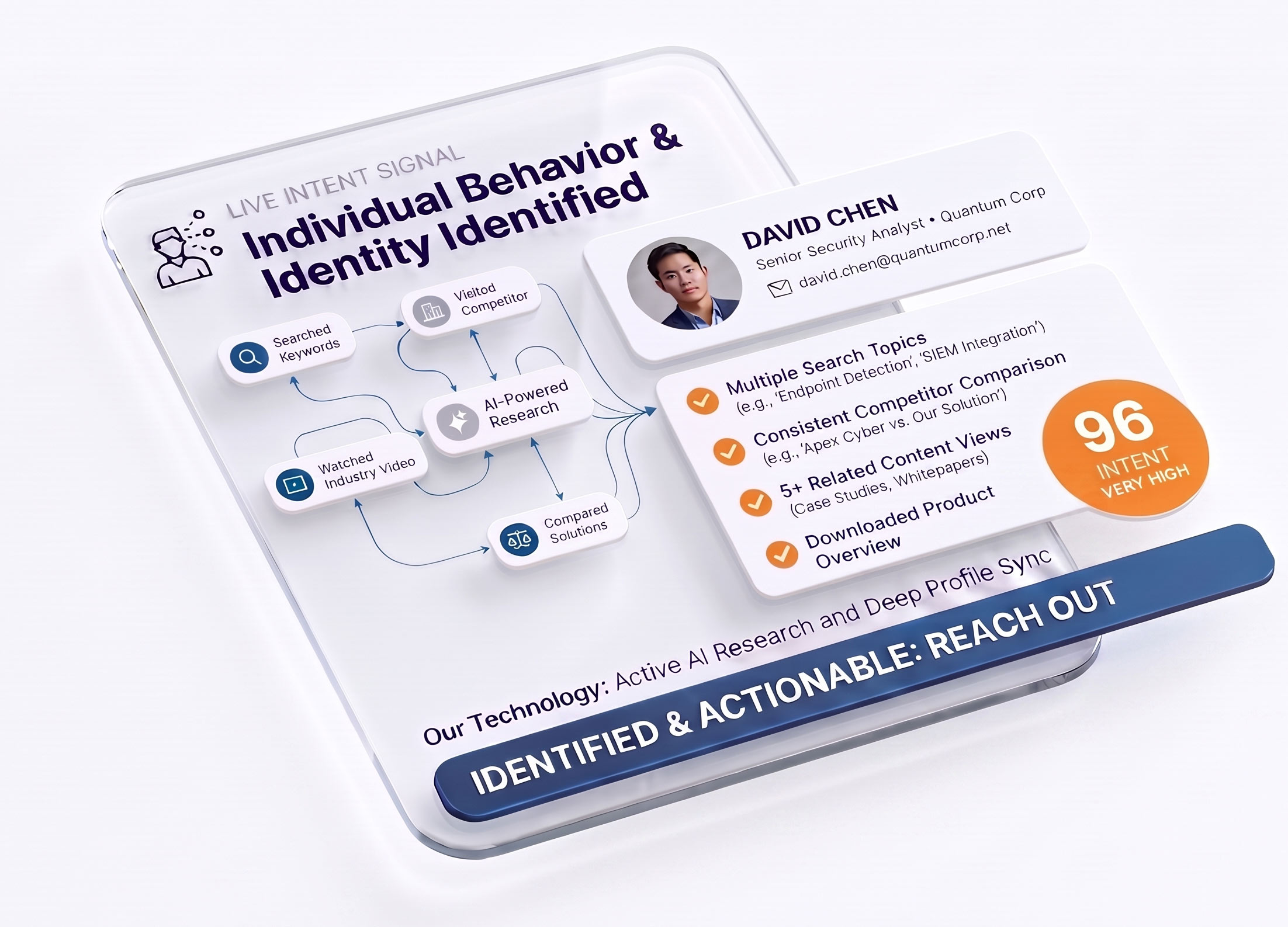
Intent data is behavioral information that signals a person’s interest in, or active research around, a specific topic, product, or category. It’s the digital trail someone leaves as they move through the awareness-to-purchase journey — the searches they run, the content they consume, the pages they visit, the forms they fill out, and the ads they click.
The core insight behind intent data is simple: behavior predicts intent. Someone who has visited three competitor websites, read two blog posts about enterprise software pricing, and watched a product demo video is not idly browsing. They’re in a buying cycle. Intent data lets you identify those people — and reach them — before your competitors do.
This is fundamentally different from demographic data. Demographic data tells you who someone is: their age, job title, company size, income bracket. Intent data tells you what they’re doing right now. And for marketing purposes, what someone is actively doing is far more predictive of purchase behavior than who they are on paper.
The Three Types of Intent Data
Intent data comes from three distinct sources, each with its own strengths and limitations.
First-Party Intent Data
First-party intent data is information you collect directly from your own channels. It includes:
- Website visits and page-level behavior (which pages, how long, how deep)
- Email opens, clicks, and engagement sequences
- Form fills, downloads, and content requests
- CRM activity — calls, demos scheduled, proposals reviewed
- Search queries on your own site
First-party data is the highest quality data you have. It’s real-time, directly tied to your brand, and completely privacy-compliant because visitors came to you. The limitation is scale — it only captures people who have already found you, which is a small fraction of your total addressable market.
Second-Party Intent Data
Second-party data is someone else’s first-party data, shared directly with you through a partnership or data exchange. For example, a media company might share behavioral engagement data from its publication audience with advertisers. Or two non-competing businesses might share audience insights through a formal agreement.
Second-party data is less common and typically requires established relationships, but it can be highly relevant depending on the partner.
Third-Party Intent Data
Third-party intent data is behavioral signal data aggregated at scale from across the web — collected by data providers who monitor activity across thousands of websites, content hubs, and digital touchpoints. This is the large-scale behavioral intelligence that powers solutions like Audience Smart from SmartMarketer.
SmartMarketer’s platform monitors over 280 million consumer profiles and more than 62 billion behavioral signals, giving marketers access to intent intelligence that extends far beyond their own website. Third-party intent data answers a crucial question: what is your target audience doing when they’re not on your website?
The power of third-party intent data is scale. You can identify in-market buyers across your entire addressable market, not just the slice that has already discovered your brand.
Where Intent Data Originates: The Signal Sources
Understanding where intent signals actually come from helps you evaluate the quality of any data provider. High-quality intent data draws from multiple signal types:
- Content consumption signals: Reading, sharing, bookmarking, or time-on-page for articles related to specific topics or categories
- Search behavior: Keyword-level queries that indicate research intent across search engines and content platforms
- Website visitation patterns: Which sites someone visits, how often, and in what sequence — identified through pixel networks and co-op data
- Ad engagement: Clicks, video views, and interaction with category-specific advertising
- Form and conversion activity: Downloads, quote requests, and other conversion-adjacent actions taken elsewhere on the web
- Social listening signals: Topic engagement and community participation patterns
The richness of intent data comes from combining these signals. A single page visit means little. But a consumer who has read four industry articles, visited two competitor sites, clicked a comparison ad, and searched related keywords over the past 14 days — that’s a high-confidence intent signal.
Intent Data vs. Demographic Data: A Critical Distinction
For decades, marketing targeting was built primarily on demographics. Reach adults 25–54 with household incomes above $75K. Target IT directors at companies with 500+ employees. These parameters still have value for brand reach, but they’re a blunt instrument for conversion-focused campaigns.
Here’s why behavioral intent data outperforms demographics in most conversion scenarios:
- Timing is everything: Demographics describe a static category. Intent data captures someone in an active buying window. A 45-year-old IT director isn’t in-market for enterprise software 365 days a year — but they might be for 30 days during a specific procurement cycle. Intent data finds that window.
- Relevance reduces waste: When you know someone is actively researching your category, you eliminate the spend wasted on demographic matches who have zero current interest.
- Intent signals are self-selecting: The behavior itself tells you the person is engaged. Demographics tell you nothing about current motivation.
The strongest targeting combines both: demographic filters ensure relevance to your ICP, while behavioral intent signals ensure timing and purchase proximity.
Practical Use Cases: Intent Data Across Marketing and Sales
Intent data isn’t a single tactic — it’s an input that improves nearly every marketing and sales function.
Programmatic Advertising
The most direct application. Build audiences of high-intent buyers and serve them targeted display, video, or native ads through a DSP. Because you’re targeting people who are already in a research or consideration phase, conversion rates and ROAS improve significantly compared to demographic-only targeting.
Content Marketing and SEO
Analyze the topics your intent audience is consuming most heavily. This tells you which content gaps to fill, which formats are performing in your category, and which questions your target buyers are asking before they engage with sales.
Sales Prioritization and Lead Scoring
For B2B teams, intent data transforms pipeline prioritization. When your CRM is enriched with behavioral signals, sales reps can focus outreach on accounts showing active buying intent rather than working cold lists. Response rates improve dramatically when you’re reaching people who are already researching your category.
Retargeting and Nurture Campaigns
Layer intent data onto your retargeting audiences to improve prioritization. Not every visitor has equal intent — someone who spent eight minutes on your pricing page carries a different signal than someone who bounced after two seconds from a blog post. Intent-enriched nurture sequences convert faster.
Market Intelligence and Trend Analysis
Aggregate intent signals across a category to understand market momentum. Which topics are seeing surging research activity? Which competitor names are being researched alongside yours? This intelligence shapes product positioning, messaging strategy, and campaign timing.
Getting Started: How to Make Intent Data Work for Your Business
The most important first step is making sure your measurement foundation is solid. You can’t layer external intent intelligence on top of broken internal tracking. Make sure your website is capturing behavioral signals accurately — every product page view, every content download, every form engagement.
From there, the path forward is about layering. First-party behavioral data from your own site tells you about your known audience. Third-party intent data from providers like Audience Smart expands your view to the full in-market population — the buyers who are researching your category but haven’t found you yet.
Understanding which data sources apply to which stages of your funnel, and how to combine them for maximum impact, is exactly what the Traffic Intelligence Evaluation is designed to help you think through.
If you’re ready to understand what behavioral intent signals look like for your specific market — and how to act on them — request your Traffic Intelligence Evaluation. SmartMarketer’s team will audit your current data infrastructure and show you exactly where intent data can improve your targeting, conversions, and return on ad spend.




Следите за свежими событиями игровой индустрии вместе с нашим разделом новостей. Здесь мы разбираем громкие анонсы, первые детали, даты выхода игр, патчи, дополнения и события киберспорта. Получайте актуальную информацию о рейтинг казино-онлайн для ПК, консолей и мобильных устройств: от крупных блокбастеров до необычных инди-игр. Мы рассказываем о том, что действительно обсуждают игроки, какие новинки готовятся к релизу и какие изменения уже появились в любимых играх.