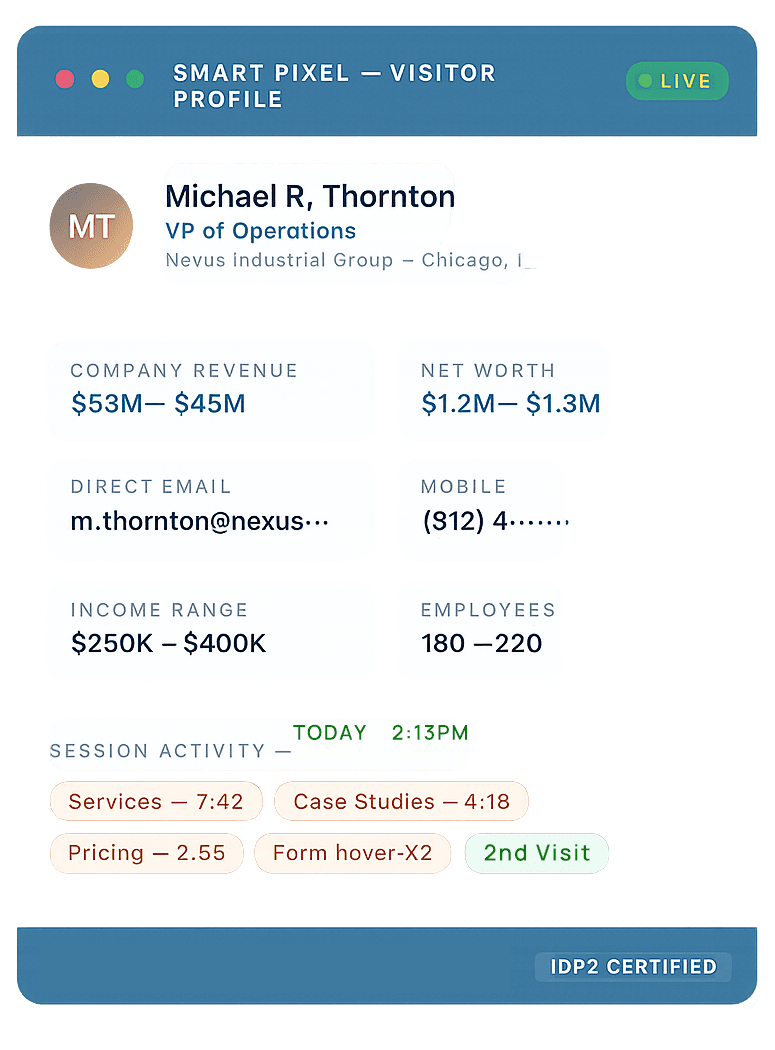
For most B2B companies, website traffic is a background metric.
It shows up in dashboards.
It gets mentioned in monthly reviews.
And then everyone moves on to more “important” things.
This company did the same — until they gained a way to see what was actually happening behind the traffic.
The Problem Wasn’t Lead Volume
On paper, everything looked fine.
They were driving consistent traffic.
Forms were converting at a reasonable rate.
Sales had opportunities in the pipeline.
But something felt off.
Sales kept saying:
“We’re talking to people… just not always at the right moment.”
Marketing kept saying:
“Engagement looks good, but it’s hard to tell what’s real interest.”
Both were right — and both were missing the same thing.
The Shift Was Visibility, Not Volume
Instead of asking how to generate more leads, they asked a different question:
“What signals are we missing before someone ever reaches out?”
Historically, that question didn’t have a good answer.
Most teams only saw:
- Pageviews
- Aggregated reports
- Lagging indicators
What changed was their ability to connect visitor identification with real behavioral metrics,
so interest could be seen as it was forming, not weeks later.
That reframed the website entirely.
What They Started Seeing (That Wasn’t Visible Before)
With that visibility in place, patterns appeared quickly.
Not guesses.
Not assumptions.
Actual, observable behavior.
They could now see:
- Companies returning repeatedly over short periods
- Specific pages viewed in deliberate sequences
- Behavior that lined up with active evaluation cycles
None of this showed up as form fills.
But once behavior could be tied back to real visitors and accounts, it became clear that
decisions were starting much earlier than they had been treating them.
Sales Didn’t Need More Leads — They Needed Awareness
Sales wasn’t asking for more names.
They wanted:
- Context
- Timing
- A way to prioritize their day intelligently
By combining visitor recognition with behavioral signals, they were able to surface a
short, daily list of accounts showing real activity.
Not “hot leads.”
Just clear attention.
For the first time, sales could see who was actively evaluating — even if no one had raised their hand yet.
Conversations Changed Because Timing Changed
Outreach sounded different almost immediately.
Reps weren’t guessing why someone might care.
They had behavioral context.
Instead of:
“Just following up…”
It became:
“We’re seeing increased interest around X — happy to be helpful if it’s useful.”
The conversations felt natural, relevant, and well-timed — because they were.
Not earlier than appropriate.
Not later than ideal.
Right when interest was active.
Marketing Finally Had Feedback That Mattered
Marketing benefited just as much.
They could now see:
- Which content attracted serious evaluation
- Which campaigns drove repeat engagement
- Where interest accelerated — or stalled
Not in abstract reports.
In real behavior tied to real visitors.
That changed how decisions were made and how quickly they could adjust.
The Outcome Was Consistency, Not Hype
There was no dramatic spike.
What changed was reliability.
- Sales had meaningful conversations every day
- Marketing worked from live signals instead of assumptions
- Leadership finally saw alignment between effort and outcome
The website stopped being a passive asset.
It became a source of daily insight.
The Bigger Lesson
For years, teams treated early-stage interest as unknowable.
Not because it didn’t exist —
but because they didn’t have a way to see it.
Once visitor identification and behavioral metrics were connected, that blind spot disappeared.
And when you can see interest sooner, everything downstream gets easier.
Not louder.
Not more aggressive.
Just better timed.